


I was 8 years old in 1991 when my mom explained to me that Louisiana’s race for governor that year was between “a crook and a Klansman.” David Duke, the Republican candidate, had been a former Grand Wizard of the Ku Klux Klan before running for president and then governor of our state. Democrat Edwin Edwards, who was later convicted on federal racketeering, extortion, and fraud charges related to rigging riverboat casino licenses, ultimately won the election thanks to 80% of Black voters turning out and voting unanimously for the guy who wasn’t in the KKK. But a clear majority of low-income white people in the state had cast their vote for the Klansman. Per the archived NYT story:
Mr. Duke’s strongest support came from low- and middle-income whites. He got 56 percent of the vote of whites with family incomes under $15,000, 63 percent of those making from $15,000 to $29,999, and 60 percent of those making from $30,000 to 49,999.
But 51 percent of whites with family incomes from $50,000 to $74,999 voted for Mr. Edwards, and 66 percent of those with incomes $75,000 and over supported him.
To reiterate, this was 1991.
Twenty-five years later, six unelected, lifetime-appointed Klansmen on the Supreme Court have gutted the landmark 1965 Voting Rights Act that protected minority voting representation in the South, declaring that it’s not necessary anymore because racism is over. Things “have changed dramatically’” in the South “in the decades since the passage of the Voting Rights Act,” Justice Alito wrote in his majority opinion. When the VRA was passed, “the Nation had faced nearly a century of ‘entrenched racial discrimination in voting,’” but “Black voters now participate in elections at similar rates as the rest of the electorate.” (The example he uses is the 2008 election, when Obama was on the ballot, which was of course an anomaly.) In fact, Alito writes, allowing for the existence of any majority-Black districts in a state like Louisiana—where a third of the population is Black—actually discriminates against Republicans, because Black voters generally vote for Dems.
In other words, you can draw up districts in the shape of bearded dragons to squeeze out extra seats for Republicans, but you can’t draw the districts in such a way that ensures racial minorities have any representative voting power in their state—even though Congress passed a law mandating exactly that after Black people were literally murdered for trying to vote.
What this decision means, in effect, is that Deep South states including Louisiana, where the case originated, are free to carve up majority-Black areas like New Orleans in a way that fully dilutes their voting power and hands representation of the state entirely over to white Republicans. And right on cue, Gov. Jeff Landry (R) suspended Louisiana’s primary elections—in which people had already begun casting votes—to redraw the state’s congressional maps to eliminate both majority-Black districts.
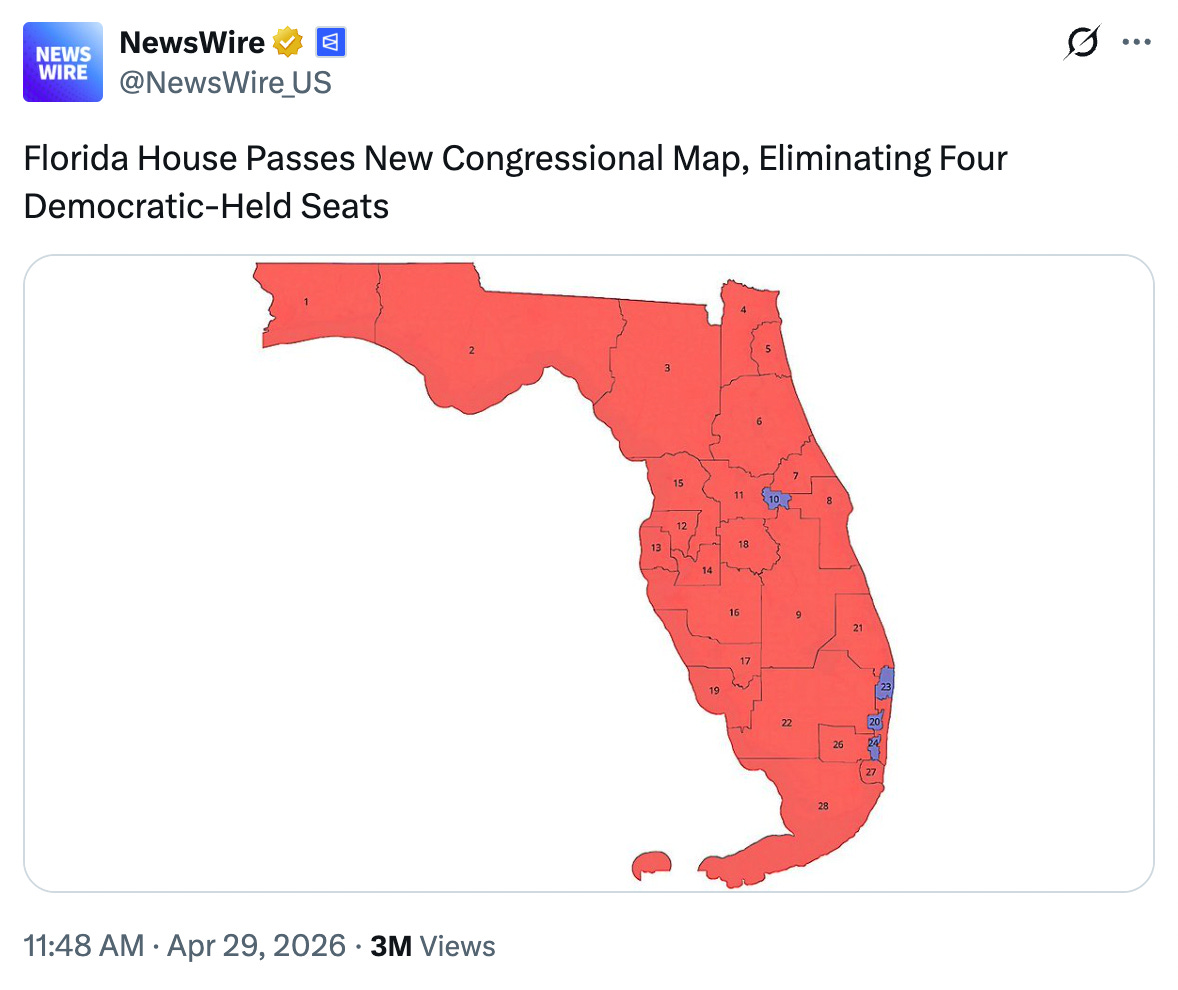
This comes two days after Ron DeSantis redrew Florida’s map to look like this:
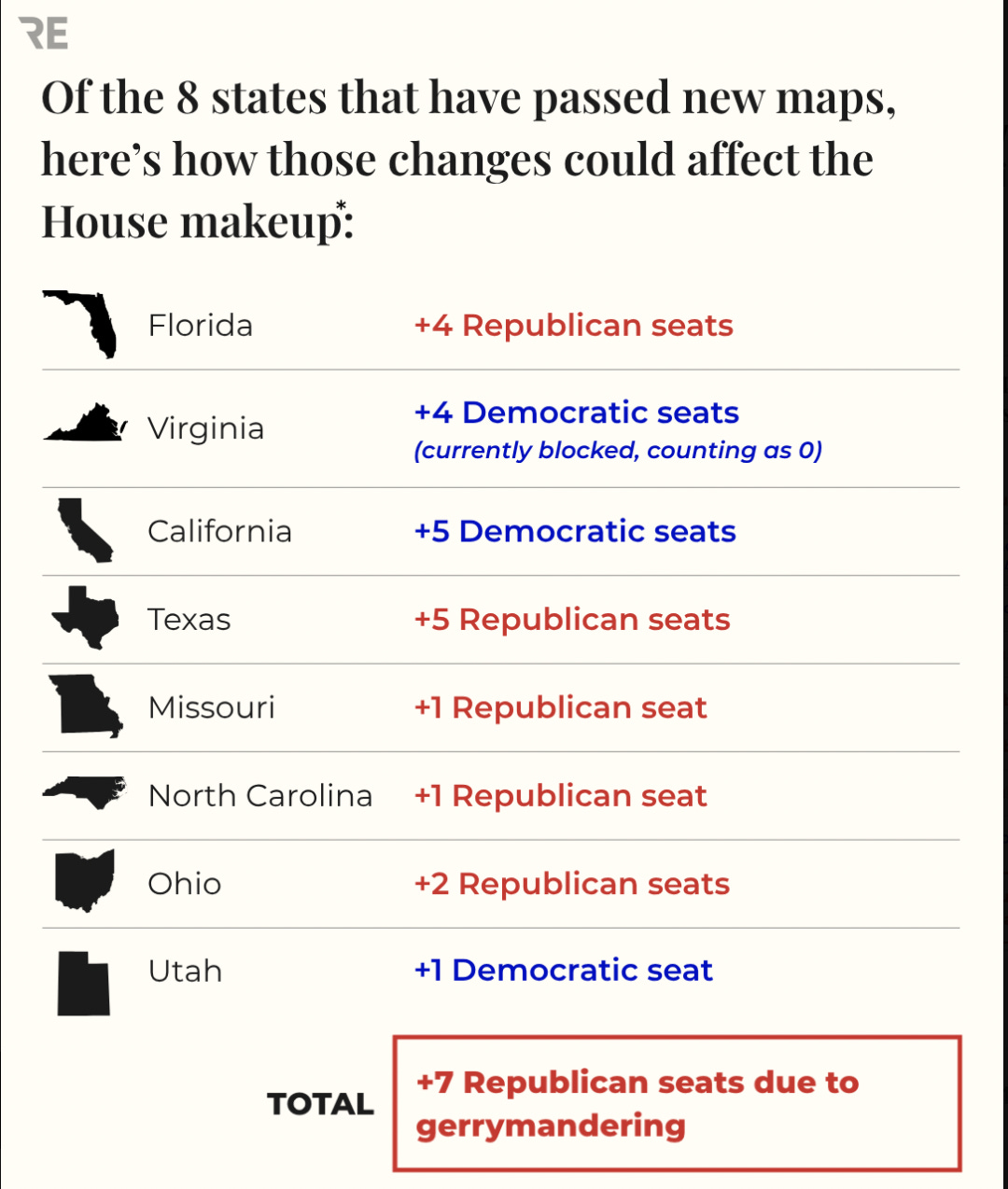
Now if we’re going to talk purely about numbers ahead of the midterms, blue states can play this game too. California and Virginia have redrawn their maps in response to Texas starting all of this (with the caveat that California and Virginia put the redistricting referendum to statewide vote, rather than just having the governor cram the new maps down people’s throats). So before Louisiana’s latest move, the nationwide redistricting games were set to net roughly seven House seats for Republicans:
Even with Louisiana’s new gerrymander, Democrats are still quite likely to take the House in the midterms. The road is a bit bumpier, and it’s more imperative than ever this year that people get off their asses and vote, but Democrats very much can still take the House and even the Senate in 2026. The Senate polling right now in Texas gives a sense of how dark the situation is for Republicans, even in the reddest of red states, where Democrat James Talarico is showing a comfortable lead over both Republicans:
The important thing for Democrats to start thinking about is what they can do with the small window of power the people give them this year, if they manage to win it. Without radical change, democracy is lost—and Black and brown people disenfranchised—for a generation. They need to expand the Supreme Court to dilute the power of Trump and Bush’s appointees, who are ruling the country by shadow docket and casually rewriting federal laws. They need do something about gerrymandering, be it forcing all states to redraw fair districts via independent commissions or some better idea above my pay grade. They need to pass that stronger, more ironclad update to the Voting Rights Act that former Joe Manchin somehow had the power to tank by himself in 2022. They need to write their own version of Project 2025, which bulldozes through red tape to protect the country from future Donald Trumps and Stephen Millers and actually improve people’s lives, should they win the presidency in 2028. Have a plan. Be a party worth voting for. Otherwise, we’re barreling toward a system of all-red states vs. all-blue states that will feel very much like the Union vs. the Confederacy, and it probably will lead to a second Civil War.
I will never be one of those people saying “blue states should just secede” or “the South should just secede,” because I love Louisiana and a whole lot of the people there there despite its insidious leadership, and I believe Louisiana belongs in this country and deserves better than freefalling back into the Jim Crow era. With that said: Everybody down there better be screaming about this shit from the rooftops from now until November.
Yes. this is the dems last chance to stem the red tide… and they need to start Yesterday.
Jeff Landry - 😱😞😡